Sacred Destinations

The Monastery, Petra 

The Monastery, Petra
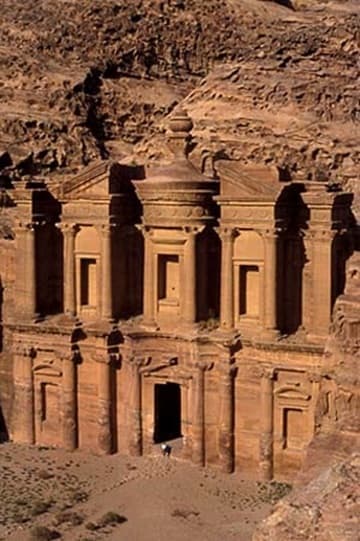
The Monastery's huge facade stands atop a mountain above the ancient
city of Petra. Photo Creative Commons License Roel Meurders.

The Monastery, Petra
View of the Monastery from above. Photo © Sacredsites.com

The Monastery, Petra
Photo Creative Commons License Joan Rubió.

Monastery, Petra
Photo © FreeStockPhotos.com.

Framed view
Photo Creative Commons License David Bjorgen.

Location map and aerial view of The Monastery. For a larger interactive view, see our Petra Map.


Giving the Treasury a run for its money as the most impressive monument at Petra is the Monastery (a.k.a. al-Deir or ad-Dayr in Arabic), which is about an hour's climb north of Petra's city center.

The Monastery is beautifully carved, though much less decorated than the Treasury, and so huge that even the doorway is several stories tall. Its name, like most Petra structures, does not reflect reality: it was probably a Nabatean temple.

History

Like the "Treasury," the name "Monastery" is a rather inaccurate nickname, which is probably based on its remote location and some inscribed crosses in the interior. Althought it may have been later used as a church (or even a hermitage), it was probably a temple. It may have been dedicated to the deified Nabatean king Obodas I, who reigned in the 1st century BC.

What to See

The Monastery is similar to design to the Treasury, but it is much larger (50 m high x 45m wide) and much less decorated. The facade is flat on the lower level and deeply carved on the upper level, with engaged columns and two half-pediments flanking a central urn (10m high).
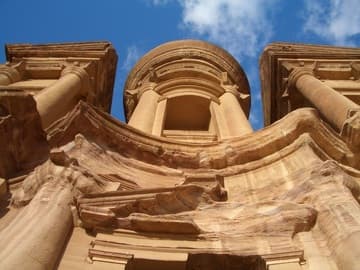
The flat plaza in front was carved out of the rock, perhaps to accommodate crowds at religious ceremonies. It was originally surrounded by a colonnade. The interior consists of a single room with double staircases leading up to a niche (the same layout as in the Qasr al-Bint and the Temple of the Winged Lions).

On the left side of the facade, there is a very steep path that tourists are generally not permitted to climb, both for the safety of the monument and the visitors. It leads up to the urn on top of the facade. Local kids like to show off by playing on the urn, some even climbing it all the way to the top.

A cave located directly opposite the Monastery houses a small café offering refreshments and a shady place to sit and admire the monument. Other monuments in the area include a stone circle and a cave, and marvelous views can be had by a few minutes' climb up the rocks behind the café.

Getting There

The Monastery is an hour's climb northwest of the city center on an ancient rock-cut path of about 800 steps. The path begins behind the Basin Restaurant and Nabatean Museum.

It may sound daunting, but there are plenty of places to rest, and donkeys available to rent. Two-thirds up is a peaceful spring, and there are various other minor points of interest along the way, such as the Lion Triclinium.

The best time to climb to the monastery is in the afternoon, when the path is mostly in shade and the sun is shining on the Monastery's facade.

Quick Facts

Site Information
Names: The Monastery; al-Deir
Location:Petra, Jordan
Faith:Nabatean
Category: Temples; World Heritage Sites
Architecture: Nabatean
Date:1st century BC
Size:Height: 50m
Width: 45m
Status:ruins
Visitor Information
Coordinates: 30.348352° N, 35.437753° E   (view on Google Maps)
Lodging:View hotels near this location

Note: This information was accurate when published and we do our best to keep it updated, but details such as opening hours can change without notice. To avoid disappointment, please check with the site directly before making a special trip.

Travel Resources

Article Sources

  1. The Rough Guide to Jordan, 2nd ed.
  2. Lonely Planet Jordan, p. 197.
  3. Petra - Wikipedia


Last updated on August 6, 2009.


Sacred Destinations Home     About     Contact     Using Images     Advertise     Blog     Twitter     Privacy Policy
Stock photos of religious art and architecture for licensing: Art History Images
Except where indicated otherwise, all content and images © 2005-11 Sacred Destinations. All rights reserved.

Sacred Destinations is an online travel guide to sacred sites, pilgrimages, holy places, religious history, sacred places, historical religious sites, archaeological sites,
religious festivals, sacred sites, spiritual retreats, religious travel and spiritual journeys.
Free content for your Google homepage or website! Get the Sacred Destinations Daily Photo Gadget

Travel resources: Spiritual Tour Directory, Sightseeing Tours, Hotels, Travel Insurance
Popular categories: Biblical Sites, Cathedrals, Catholic Shrines, Footsteps of Jesus, Luther Sites, Megalithic Mysteries
Popular sacred sites: Easter Island, Lourdes, Notre-Dame Cathedral, Oberammergau Passion Play, Shroud of Turin, Sistine Chapel, St. Mark's Basilica, St. Peter's Basilica, Stonehenge
Popular city guides: Rome, Ravenna, Ephesus, Assisi, Paris, Jerusalem
Popular maps: England Map, Italy Map, Jerusalem Map, London Map, Paris Map, Rome Map