Santa Maria in Cosmedin, Rome
Best known for the "Mouth of Truth" in its porch, Santa Maria in Cosmedin is one of the most interesting churches in Rome, with important medieval art, an unusual crypt, and an atmosphere of antiquity.
History of Santa Maria in Cosmedin
Santa Maria in Cosmedin stands on the site of an ancient Roman temple to Hercules Invictus, which was last rebuilt in the 2nd century BC. In the 4th century AD, a portico (loggia) was built against the northwest side to house the Statio Annonae, the Roman market inspectors' office.
Around 600 AD, the spaces between the loggia's columns were filled in to form a hall used as a diaconia (Christian welfare center for the poor).
This multi-layered complex was transformed and expanded into a large church, most of which still stands today, by Pope Hadrian I (772-95). He demolished the above-ground parts of the pagan temple and the back wall of the portico in order to extend the diaconia into a basilica with three aisles.
The church was given to Greek refugees fleeing the iconoclastic conflicts in the East and was initially referred to as the aecclesia Grecorum (Greek church) or schola Graeca (Greek community). By the early 9th century, the Greek congregation were calling their church Mariae in Cosmedi, Maria in Cosmedin. "Cosmedin" comes from the Greek word for "ornament" or "decoration" and probably refers to the rich decorations Hadrian provided for the interior. Unfortunately, virtually none of that survives today.
Santa Maria in Cosmedin was restored and expanded by Pope Nicholas I (858-67), who added an oratory, a triclinium and a papal residence and decorated the nave with frescoes.
Following damage by the Norman invasion in 1084, further remodelling took place in the 12th century under Popes Gelasius II and Callixtus II. This including the addition of the Romanesque tower and the marble furnishings in the chancel by the Cosmati brothers.
More renovations followed in later centuries. The facade was remade in the Baroque style in the 18th century, but in 1869-99 the church was restored to its ancient origins by Giovanni Battista Giovenale.
What to See at Santa Maria in Cosmedin
Restored to its early medieval appearance, the attractive facade has a porch with seven open arches and seven windows. Rising to the right is a tall, slender Romanesque belltower added in the 12th century.
Traces of the earlier buildings can be glimpsed on the exterior. On the northwestern (left as you face the church) part of the north wall, there are remains of the columns and arcades of the 4th-century loggia facade as well as the early 7th-century blocking walls that formed the diaconia. In both the aisle walls there are ten round-headed windows (five on each side) from the 8th-century church and large tufa blocks reused from the Roman temple. The 8th-century clerestory, with six windows on each side, is also visible.
In the porch, the greatest attraction is the Bocca della Verità, "Mouth of Truth." The large marble mask is an ancient Roman artifact that was either a drain cover or part of a fountain. It was placed here in the porch in 1632. Its name and popularity derive from a medieval legend that if a liar placed his hand in its mouth, it would be bitten off. The legend was charmingly tested by Audrey Hepburn and Gregory Peck in the film Roman Holiday, only adding to its popularity. Today visitors line up in the porch for their turn to be photographed with their hand inside.
Also worth a look in the porch, if you can see past the crowds, is the 11th-century doorway carved with Classical designs by Giovanni di Venetia, some old inscriptions, and a medieval tomb canopy with traces of frescoes underneath.
The interior of the church has been mostly restored to its appearance in the 8th century with some of the additions from the 12th century. The church has three aisles, no transept, and three apses at the east end. Columns from the 4th-century loggia can be seen in the west (back) and north (left) walls.
The nave is divided from the aisles by wide pillars alternating with columns, for a total of two pillars and nine columns on each side. The classical columns are topped with finely carved capitals, some reused from Roman buildings and some made in the 8th century. The nave is lit by 27 small windows at the top of the clerestory.
High in the clerestory and along the top of the triumphal arch are remains of 11th-century frescoes. The rest of the walls, where the Baroque decoration has been stripped away, are left bare. The apse frescoes are modern, in imitation of the medieval style. Traces of actual medieval frescoes can be seen emerging from beneath the modern ones in the central apse. One hopes these will eventually be revealed in their entirety!
The fine nave pavement and marble furnishings at the front of the nave - the schola cantorum, pulpit, paschal candlestick, altar canopy, and episcopal throne - all date from the 13th century, the work of the Cosmati family. A dedicatory inscription runs along the top of the choir screen. The altar canopy, known as the Ciborium of Deodatus, is in the Florentine Gothic style and dates from 1294.
The main relic enshrined by the church today is the skull and bones of St. Valentine, which are usually on display in a glass reliquary and brought out for his feast day on February 14.
Before you leave be sure to stop by the sacristy, which is now a crowded gift shop. On the back wall, in a wood frame, is a fragment of an 8th-century mosaic. It was a small part of a great mosaic commissioned by Pope John VII (705-07) for an Oratory of the Virgin inside the old St. Peter's Basilica.
The full mosaic measured 9 meters long by 6 meters high and centered on a large portrait of the Virgin with the pope, surrounded by seven scenes from her life. This is part of one of the seven scenes, depicting the Adoration of the Magi. It was donated to the church in 1639. Other pieces are in the Vatican Grottoes, in Florence, and in Orte.
Beneath the altar of the basilica is an 8th-century crypt, built by Pope Hadrian I (772-95) to house the many relics he had taken from the catacombs. Shaped like a tiny basilica, it has three aisles divided by columns, a transept and an apse. The side walls have 16 round-headed niches with marble shelves to display the relics for pilgrims. The crypt was built by hallowing out the solid podium of the ancient Roman temple; thus the floor and ceiling are made of the podium's large tufa blocks. More tufa blocks can be seen in the side walls.
Quick Facts on Santa Maria in Cosmedin
| Site Information | |
| Names: | Santa Maria in Cosmedin |
|---|---|
| Country: | Italy |
| Categories: | basilicas; churches; movie locations |
| Dedication: | Virgin Mary |
| Dates: | c. 780 and later |
| Status: | active |
| Visitor and Contact Information | |
| Coordinates: | 41.888137° N, 12.481617° E |
| Address: | Piazza della Bocca della Veritas 18 Rome, Italy |
| Phone: | 06-6781419 |
| Hours: | Summer: daily 9am-8pm Off-season: daily 9am-5pm |
| Lodging: | View hotels near Santa Maria in Cosmedin |
References
- Personal visit (April 16, 2008).
- Matilda Webb, The Churches and Catacombs of Early Christian Rome: A Comprehensive Guide
(Sussex Academic Press, 2001), 175-77.
- S. Maria in Cosmedin (1987). Multi-lingual pamphlet published by the church.
- Alta Macadam and Ellen Grady, Blue Guide Central Italy with Rome and Florence (London: Somerset Books, 2008), 77.
- Santa Maria in Cosmedin - Churches of Rome Wiki
- Santa Maria in Cosmedin - Frommer's Rome
- Cosmati family - Wikipedia
More Information
- Photos of Santa Maria in Cosmedin - here on Sacred Destinations
Map of Santa Maria in Cosmedin, Rome
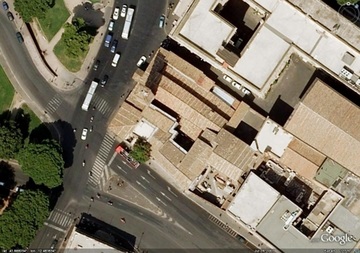
Below is a location map and aerial view of Santa Maria in Cosmedin. Using the buttons on the left (or the wheel on your mouse), you can zoom in for a closer look, or zoom out to get your bearings. To move around, click and drag the map with your mouse.